
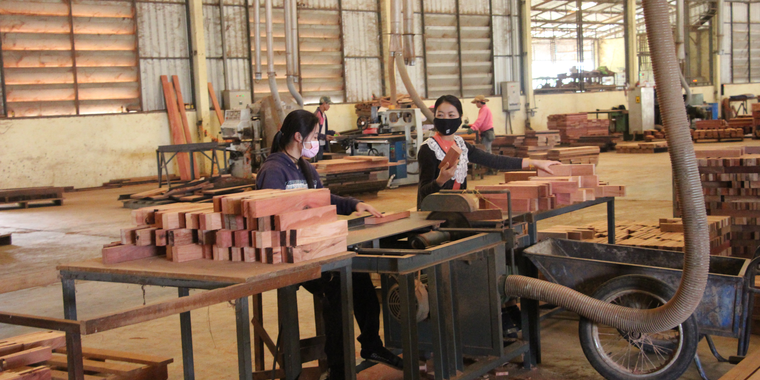
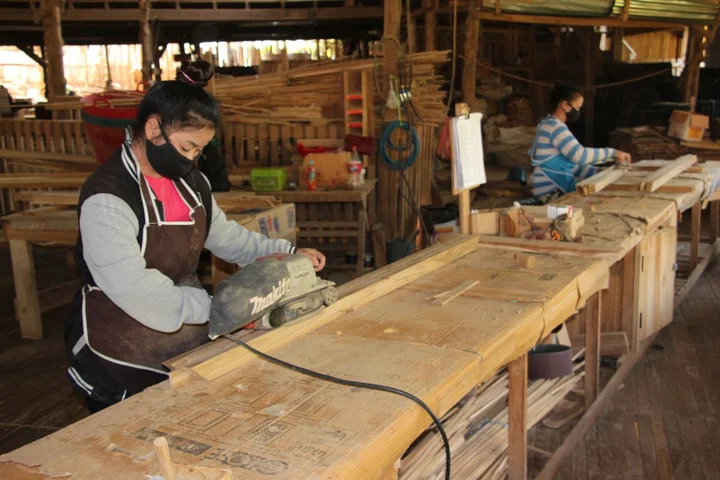
For workers in the small sawmills or furniture factories of Lao People's Democratic Republic, conditions can be far from fair. The company that employs you could suddenly close, leaving you in need of a new job. In companies that are running, if you are a man, your boss might expect you to operate heavy machinery without proper safety training. And if you are a woman, the boss might pay you less than a man who does the same work. In each case, the boss would be breaking the law, but they might not even realize.
A burgeoning partnership between Lao PDR and the European Union (EU) could force a change, boosting gender equality and improving work conditions by ensuring compliance with the law. But as a new study by RECOFTC shows there are also risks of unintended consequences for small businesses and their workers.
Tackling illegality
Recent years have been a testing time for such businesses, as Lao PDR has taken steps to stamp out illegal logging and related trade. In 2016, for example, Prime Minister Thongloun Sisoulith issued an Order called PMO15. Among other things, it imposed a moratorium on exports of logs and timber, suspended logging in production forests and strengthened controls on timber transport, processing and trade.
While PMO15 was well-intentioned, it led to the closure of many small sawmills and wood-processing factories. In 2018, the Vientiane Times reported that 349 out of 1,500 wood processing plants and more than 1,000 of 1,178 family-based furniture plants had closed as a result of the order.
PMO15 came amid Lao PDR’s ongoing negotiations with the European Union (EU) towards a Voluntary Partnership Agreement (VPA) on forest law enforcement, governance and trade. Under a VPA, Lao PDR would commit to verifying the legality of its timber product exports to the EU. By strengthening controls over the supply chain, the VPA is likely to have big implications for small businesses and the men and women working in them, as did PMO15.
Conscious of the potential risks and opportunities, a team from RECOFTC set out in 2019 to assess gender equity and social inclusion in small businesses in the context of the VPA. They focused on Xayaboury Province, interviewing workers and managers of six wood processing and furniture factories, including two that closed because of enforcement of regulations in support of PMO15.