
Menu
In focus

What does equitable governance really mean? Reflections from Nepal’s Gaurishankar Conservation Area, Nepal

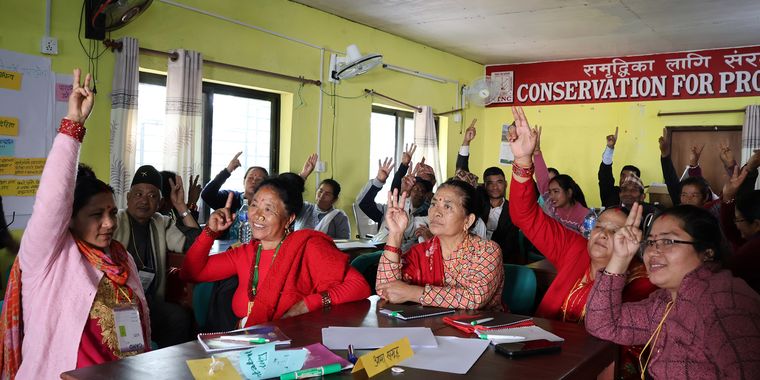
Participants completing a post-evaluation activity after the workshop in Nepal’s Gaurishankar Conservation Area
Participants completing a post-evaluation activity following the workshop in Nepal’s Gaurishankar Conservation Area.

“We use terms like accountability, transparency and participation all the time in our meetings. But what do they really mean in terms of our work?” asked Tika Devi Chudal Thapa, vice chairperson of the Shrijanshil Mothers’ Group, at the start of a two-day capacity-building workshop in Nepal’s Gaurishankar Conservation Area. “I am hoping to better understand these ideas in a way we can actually relate to.”

Gaurishankar Conservation Area is one of Nepal’s most ecologically and culturally significant landscapes. Spanning 2,179 square kilometers across Sindhupalchok, Dolakha and Ramechhap districts, it forms a vital biological corridor linking Sagarmatha and Langtang national parks. The area supports rich biodiversity and is home to forests, grasslands, glaciers and alpine scrublands, as well as diverse communities whose lives and cultures are closely connected to the landscape.

The workshop Thapa was speaking at took place at the end of 2025. in response to priorities identified during Gaurishankar Conservation Area’s site-level assessment of governance and equity (SAGE) and synthesis process conducted earlier that year.

During the assessment, participants had identified a need to strengthen their understanding of participation, decision-making, transparency and accountability in conservation governance. In response, we had brought from local government, conservation area management committees, forest management sub-groups, women's groups and Indigenous communities for two days of shared learning and reflection.

Participants of the ‘capacity building module workshop’ organized by RECOFTC Nepal in 2025.

Moving from concepts to practice

Our main focus was on helping participants understand what equitable governance looks like in practice and how these principles apply to their daily work and responsibilities. We explored how decisions are made within conservations spaces, who gets included in these processes and what barriers prevent meaningful participation.

One of the most impactful activities was the privilege walk exercise. As participants stepped forward or remained behind in response to a series of statements, the growing distance between them became a visual reminder of the unequal opportunities and challenges that shape people’s ability to participate in decision-making. The exercise sparked open discussion about power, representation and why equity matters in conservation governance.

Similarly, role-playing exercises encouraged participants to reflect on their own institutions and communities. “I realized that seeing things from another perspective pushes me to rethink how we plan and communicate in meetings at the local level,” said Binita Khadka Oli, treasurer of the Gaurishankar Mothers’ Group and member of the Kamal Mai Conservation Area Forest Management Sub-Committee.

Participants participating in priviledge walk
Participants take part in a privilege walk exercise during the workshop.

Strengthening transparency and accountability

We also wanted to ensure that participants developed a strong practical understanding of transparency and accountability. Through interactive exercises and group discussions, participants explored how poor communication and unclear responsibilities can weaken trust and participation within institutions.

Blindfold game related to Transparency
Participants take part in a blindfold exercise on transparency during the workshop.

Discussions highlighted the importance of transparency during planning, implementation, benefit sharing, monitoring and evaluation. Together with participants, we reflected on practical ways to strengthen accountability, including regular information sharing, accessible records, grievance-handling systems, community meetings and social audits.

We also reviewed legal frameworks related to transparency and accountability, grounding the discussions in Nepal’s broader conservation and governance context. Participants proposed actions their organizations could take to increase transparency and accountability. Improved communication and information-sharing mechanisms, strengthened documentation practices and more inclusive decision-making spaces emerged as key requirements.

A growing commitment to equitable governance

As we moved beyond theoretical discussions and engaged directly with the realities of governance in their communities, participants were encouraged not only to understand concepts such as equity and accountability, but also to consider how to apply these in practice.

When we asked Tika Devi Chudal Thapa the same question we had raised at the start of the training, she had a different response.

Tika Devi (centre) shares her experience with others.

“The training and discussions we went through together completely changed how I see my role,” she said. “Before, I thought participation was just attending meetings. But I now understand why every voice matters. This experience has helped me see where our mothers’ group is doing well and where we need to improve.”

Thapa added that sessions on transparency and accountability helped her better understand the importance of open communication, record-keeping and ensuring that information is shared clearly within communities and institutions. “I feel confident not only to contribute more meaningfully, but also to help include others,” she said. “It feels practical now, not just theoretical.”

When we got in touch with Tapa six months later, some of those changes were already visible in how the mothers’ group conducted its meetings and activities. “After the workshop, we started applying what we learnt in the way we conduct our meetings and group activities,” she told us. “We now pay more attention to proper meeting processes, maintaining minutes carefully and ensuring more inclusive participation. The training also encouraged us to focus more on women-centric capacity building, which has led us to start organizing community-level capacity-building programmes for women.”

###

Barshani Joshi is knowledge management and communication officer at RECOFTC Nepal.

‘Scaling-up equitable governance in area-based conservation’ (SEGA) is a four-year project that aims to promote equitable governance in protected, conserved and biodiversity-rich forest areas in Nepal. The project uses the Site Level Assessment on Governance and Equity (SAGE) tool to assess governance and equity in biodiversity conservation and oversee ecosystem services, including benefit-sharing schemes. Through the application of SAGE, site-level actors are empowered to improve social and conservation outcomes.

Story details

Thematic area
Governance and rights
Geographic focus
Regional
Nepal