
Menu
News

Swiss Embassy, UNEP and FAO reps witness sustainable local action in Yogyakarta and Bandung

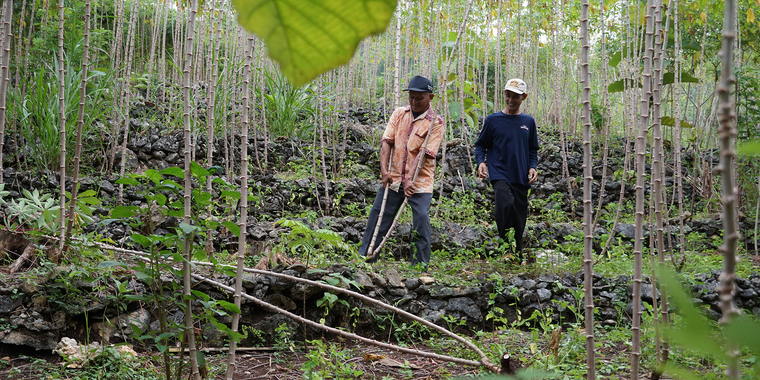
Teak farmers benefit from Wana Manunggal Lestari Cooperative, because they receive fairer prices

In June 2025, RECOFTC Indonesia received a delegation from the Embassy of Switzerland in Indonesia, the United Nations Environment Programme (UNEP) and the Food and Agriculture Organization (FAO).

The visits were part of the ‘Climate change mitigation through social forestry actions in ASEAN countries’ project, and took place in two locations – Gunungkidul Regency, Yogyakarta and Bandung Regency, West Java.

Among the delegates were Tessa Nerini, first secretary and deputy head of the Political, Economic and Cultural Affairs division at the Swiss Embassy, Indonesia. The group also included FAO’s Sesia Fitri Anisa, national forestry and climate change specialist and Ade Tamara, social forestry and climate change specialist. And from UNEP, we had Alexis Maxime Corblin, senior technical advisor and John Narayan Parajuli, communications specialist.

The group was accompanied by RECOFTC Indonesia staff headed by Gamma Galudra, country director, Reny Juita, social forestry partnership coordinator, Lissa Gabriella, training coordinator and Gomos Anditio Purba, programme assistant.

On 22 June 2025 the team travelled to Gunungkidul Regency, Playen subdistrict, where they met with representatives from the Sedyo Makmur Community Forest and the Wana Manunggal Lestari Cooperative. They talked about institutional development and teak-based social forestry business planning.

Female worker in CV Karya Wahana Sentosa cut the teak wood from the Wana Manunggal Lestari Cooperative

Members of the Wana Manunggal Lestari Cooperative shared that their teak harvests are sold to CV Karya Wahana Sentosa, a private company that manufactures furniture and houseware. The delegates were taken to CV Karya Wahana Sentosa, where they were observed multiple steps in the teak value chain – from raw timber to final wooden products sold in retail stores.


A visit to the Wana Manunggal Lestari Cooperative

“As a production cooperative managing teak from social forestry schemes, we need solid business strategies, including on proper utilization of non-timber products like corn and cassava,” said Puji Raharjo, production manager of Wana Manunggal Lestari Cooperative. “Through the cooperative, farmers can secure better prices for their products, cutting out inefficient and unfair distribution chains.”

The next day, on 24 June 2025, the delegation visited Ibun, a village in Kamojang, Bandung Regency. Here, farmers shared stories of how the Ibun Social Forestry Group was formed in 2017 and the progress they have made so far. The delegation visited the group's coffee plantation, coffee production house and storage facilities and wrapped up the tour with a coffee-tasting session.


Discussion among Ibun Social Forestry Group

Prior to the active involvement of the social forestry group, the current agroforestry area faced forest fires every year. The planting survival rate was only 40 per cent. Members of the social forestry group started planting coffee, avocado, stinky bean and dogfruit in 2018 under a new social forestry permit. So far, the group has planted around 300,000 plants, and since the area started being managed under social forestry, there have been no forest fires. The Ibun Social Forestry Group established a cooperative in 2024 to market coffee cherries grown in the area.

Over the course of the four days, the delegation saw firsthand how social forestry empowers local communities to strengthen livelihoods, build resilient enterprises and reduce forest fire risk.

“As we have seen, when communities are trusted to manage their forests, they are able to secure better livelihoods and contribute to sustainable development,” said Gamma Galudra, director of RECOFTC Indonesia.

###

Shinta is communication officer at RECOFTC Indonesia.

The ‘Climate change mitigation through social forestry actions in ASEAN countries’ project, is an initiative under UN-REDD (UNEP and FAO), funded by the Swiss Agency for Development and Cooperation (SDC). The project is implemented in Indonesia in collaboration with RECOFTC, the Non-Timber Forest Products – Exchange Programme (NTFP-EP), Java Learning Center (JAVLEC) and Indonesia Social Forestry Management Association.