
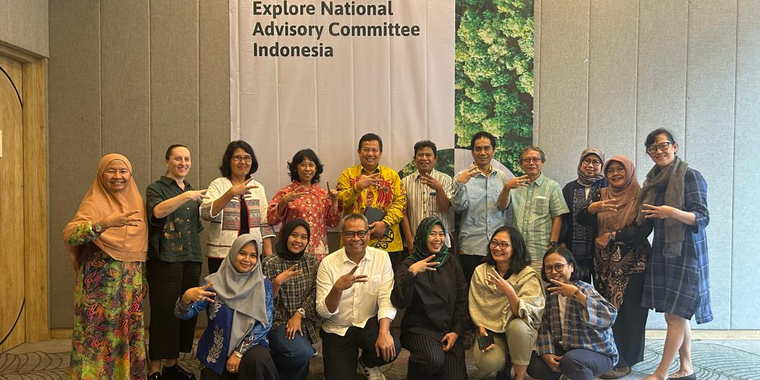
Explore’s newly formed National Advisory Committee (NAC)–Indonesia met in February 2025 to discuss strengthening the programme’s research-to-policy pathway. Members of the NAC–Indonesia convened in Bogor to meet with researchers leading Explore-supported projects in the country.
Ensuring that high-quality research translates into actionable policies that advance sustainable forest landscape governance is a key priority. The creation of NAC–Indonesia is part of a broader Explore initiative to establish similar bodies in Lao PDR, the Philippines and Viet Nam.
Working closely with RECOFTC country offices, CIFOR-ICRAF and the Forest Foundation Philippines, Explore is building networks that bridge research and policy by fostering collaboration and supporting actionable policy outcomes.
The NAC–Indonesia includes representatives from RECOFTC and CIFOR-ICRAF, policy experts and high-profile advisors of the Indonesian Ministry of Forestry (MoF). The February meeting was part of Explore’s efforts to address the long-standing challenge of translating research into policy and practice.
Aligning research with national priorities
Explore’s principal investigators (PIs) and co-PIs presented their research focus and early findings. The NAC meeting reflected upon how Explore’s research in Indonesia aligns directly with three of the MoF’s five national priorities – fairness in forest management, forest as a source of food security and preserving Indonesia’s forests as the world’s lungs.
Fairness in forest management
The research projects ‘Centering gender and ecological justice in Southeast Asia forest landscape governance’ and ‘Fair for whom? Politics, power and precarity in transformations of tropical forest-agriculture frontiers’ examine the political and social dynamics that shape forest landscapes.
Through participatory action research, these projects are looking at creating more inclusive spaces and processes for women and other marginalized groups to effectively participate in forest landscape governance. The approaches include empowerment, capacity development and fostering multi-sector partnerships.
Tools such as photo-voice essays, participatory three-dimensional mapping, capacity-building and community social forestry planning are central to advancing ecological justice and gender equity.
Forest as a source of food security
‘Mainstreaming forest landscape governance based on forest-water-energy-food nexus toward sustainable forest landscape management in Indonesia’s border areas’ and ‘Enhancing community resilience of socioecological production landscapes with agroforestry, in Southeast Asia’ projects contribute to positioning forests as key to food security.
The projects place a strong emphasis on co-developing landscape plans with local stakeholders, prioritizing the inclusion and equity of women and other marginalized groups to ensure that vulnerable populations benefit from the development of landscape initiatives. The tools they use enhance transparency and accountability in forest governance, facilitating data-driven decision-making.
Digital tools such as ALCAMS (Agroforestry Land Capability Assessment and Mapping Schemes) and modelling are used to gather and visualize data, providing valuable insights to guide more equitable and sustainable planning of forest landscapes.
Preserving Indonesia’s forests as the world’s lungs
‘Collaborative forest landscape governance towards a resilient and sustainable future’ looks into preserving Indonesia’s forests as the world’s lungs. The project centres on the Way Betung watershed, a critical ecosystem for carbon sequestration and climate change mitigation.
The project strengthens collaborative processes for forest landscape governance focused on conservation, restoration and long-term, sustainable outcomes. Opportunities for gender equality in governance and collaborative action planning for landscape stakeholder collaboration are essential.
Collective insights through the NAC–Indonesia
Members of the NAC–Indonesia and Explore researchers discussed strategies to bridge research and policy. They emphasized the need for policy briefs and knowledge products to engage government decision-makers on critical issues, including agroforestry, food security and forest management.
The meeting marked a major step in strengthening the research-to-policy pathway of Explore in Indonesia. By connecting research with national priorities and researchers to national government advisors and policy experts, Explore hopes to shape equitable and sustainable forest landscape governance from the local through to the national level. These efforts will ensure that Explore-supported research remains relevant and responsive to Indonesia’s evolving forest and environmental governance priorities.
Lessons from NAC–Indonesia will guide the establishment of NACs in other Explore focal countries. Each NAC will need to align with national priorities while contributing to a shared regional outcome of improved forest landscape governance across Southeast Asia.
As Explore works closely with RECOFTC country offices, CIFOR-ICRAF and the Forest Foundation Philippines, the programme will continue to build networks that bridge research and policy by fostering collaboration and supporting actionable policy outcomes.
###
About Explore
Explore is a research network and community of practice dedicated to expanding and applying knowledge on forest landscape governance in Southeast Asia. The network is funded by the government of Sweden. It is hosted by RECOFTC, in partnership with the CIFOR-ICRAF, in collaboration with universities, research institutes, governments, civil society organizations, local communities and the private sector in Southeast Asia.
For more information about Explore, contact [email protected].
To learn more about Explore, click here.
Sophie R Lewis is senior policy outreach and gender inclusion coordinator at RECOFTC.