
Across Asia, forest landscapes are under growing pressure from agricultural expansion and infrastructure development, as well as climate change and biodiversity loss.
On paper, the Model Forest approach makes sense as a way to address these challenges. By bringing diverse stakeholders together to manage landscapes sustainably through shared strategies, Model Forests promise to balance social, economic and environmental goals.
But does this approach work? To answer this question, the Regional Model Forest Network–Asia (RMFN–Asia) and its member Model Forests have developed a monitoring framework and published a related set of guidelines for implementing it.
A framework to support decision making
The Model Forest Indicator Framework (MFIF) enables the groups managing Model Forests to measure progress in each of four linked areas: ecosystem health, governance, production and human wellbeing. For each of these pillars, the framework includes core and optional indicators for users to track.
The MFIF offers a practical approach to monitoring sustainability at the landscape scale. It has been designed to help stakeholders not just measure change but also use that information to guide action and adapt management practices.
“Monitoring should not be an end in itself,” says Julian Atkinson, manager of the RMFN-Asia secretariat at RECOFTC. “Instead, it should support dialogue, learning and decision-making by the diverse groups that are working together to manage Model Forest landscapes.”
Guidelines for implementation
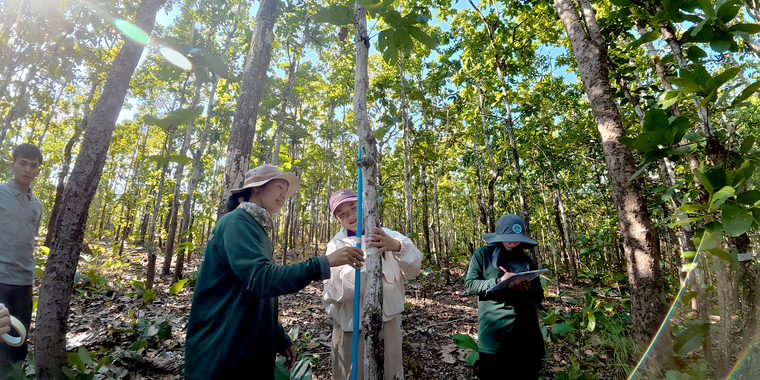
RECOFTC has recently published Guidelines for implementing the Model Forest Indicator Framework. Its contents draw on experiences in Ngao Model Forest in Thailand and Carood Watershed Model Forest in the Philippines, where pilot testing took place.
These landscapes differ widely in terms of data availability, institutional capacities and development priorities. In some cases, basic information on forest health or livelihoods was readily available. In others, the teams doing the monitoring had to start from nothing. This helped shape one of the guidelines’ central principles: Start simple and build over time.
Instead of attempting comprehensive monitoring from the outset, the guidelines promote a phased approach, beginning with priority indicators and expanding as capacity and confidence grow.
Pilot testing showed that users need more than just a set of indicators to conduct effective monitoring and make meaningful use of its results. Responding to this need, the guidelines provide users with advice on how to implement the main steps: preparing and engaging stakeholders, selecting indicators, mobilizing resources for sustainable forest landscape management, and collecting and analysing data and using the results to inform decisions.
Tracking changes over time
A key emphasis is on tracking changes over time. While one-off assessments can provide snapshots, they offer limited insight into trends or the impacts of management actions. By contrast, regular monitoring enables stakeholders to see what is working, what is not and where adjustments are needed.
Equally important is participation. The MFIF encourages the involvement of communities, government agencies, civil society groups and the private sector in defining what should be monitored and how results are interpreted. This helps build ownership of both the data and the decisions that follow.
The guidelines for implementation emphasize the processes through which data is collected, shared, discussed and used. They provide a structured yet flexible approach that helps groups using the MFIF move from fragmented data collection to a more integrated understanding of their landscape.
“During pilot testing, the MFIF helped us move beyond collecting data. By agreeing on what to monitor and reviewing the results together, we were able to identify priorities, adjust our plans and make decisions based on evidence rather than assumptions,” says Christine Vale-Zambrano, watershed development officer at Carood Watershed Model Forest. “These new guidelines will help us and other Model Forests turn monitoring into continuous learning and better decisions over time.”
###
The Regional Model Forest Network–Asia is supported by the Global Leadership Program under the Department of Natural Resources, Government of Canada. RECOFTC is the Secretariat of RMFN–Asia.