Menu
Practitioner's insights

From tree-planting to system change: Lessons from Trees4All in Thailand

Farmer in Nan managing land through diversified, resilient farming
This page is also available in

A familiar narrative has shaped conversations about forests and farming in northern Thailand. When floods strike, attention turns upstream. Images of bare mountainsides circulate, accompanied by claims that upland farmers are destroying forests while downstream communities and private companies suffer the consequences. Tree planting has emerged as a visible and politically appealing response to these anxieties, a way to show action in the face of climate risks.

RECOFTC Thailand’s Trees4All project — supported by the Wyss Academy for Nature and the International Climate Initiative (IKI) — emerged in this context. Our project site is in Santisuk district in Nan province. Nan is a mountainous province that provides about 40 per cent of the water flowing into the Chao Phraya River. But over the years, monoculture farming has replaced more than 1 million rai (160,000 hectares) of Nan’s forest. This is affecting the supply of water to the Chao Phraya River, the lives of local people, and people living downhill in both urban and rural areas.

Upland farmer in Nan maize field

From the start, it was clear to us that tree planting alone would not resolve the deeper tensions at play. When we spoke to upland farmers, many told us they would be happy to plant trees. What they questioned was how they were supposed to do this while managing debt, feeding their families and navigating farming systems that had locked them into monocropping for years. They lacked options they could trust and support to make the change.

For many upland farmers, monocropping maize or other field crops is not a choice made lightly. It is the outcome of repeated cycles of risk, market pressure and limited alternatives. Farmers have learned, often painfully, that these cropping systems are ecologically fragile and economically precarious. But this awareness does not automatically translate into change.

Past tree-planting programmes have left mixed legacies. Some promised support that never fully reached farmers. Others focused on short-term subsidies rather than long-term transitions. As a result, trust has eroded. When new initiatives arrive, farmers want reassurance that tree planting will work for them. Trees4All was designed to build trust, using tree planting not as an end goal but as a starting point.

Mobilizing two sides

Launched in February 2022, Trees4All worked on two fronts. One on side were the tree sponsors: individuals and companies concerned about climate change, deforestation and social responsibility. On the other side were famers who were willing to experiment, but only if the risks were manageable and the commitments clear.

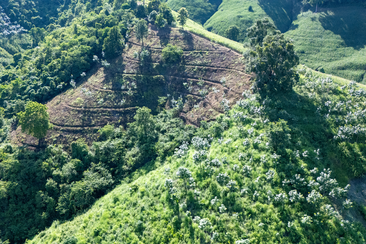
Hilly maize fields in Nan where farmers planted 40,000 trees

We launched a campaign on the Thai crowdfunding platform taejai.com, hoping to raise THB 1 million (USD 30,000) to support a hundred farmers to each plant a hundred trees. Four years later, around 300 farmers are participating, and more than 2,600 supporters have contributed, with total funds raised exceeding THB 6 million (USD 193,500). The farmers have planted about 40,000 trees.

While this growth matters, credibility matters more. A core principle of Trees4All is transparency. Donors can track where trees are planted, view annual survival reports, and see photographs of the farmers they are supporting and the trees they plant. The farmers, in turn, receive payments directly to their bank accounts once they submit required monitoring data using our app on their phones. If a tree dies, we replace it.

Native trees only

The trees planted through Trees4All are native species – mostly Dipterocarpus alatus as well as teak and rosewood – that are integrated into existing farmland rather than planted as standalone plantations. We deliberately avoided fast-growing exotics species, and we did not promise immediate market returns.

There were practical reasons for this. Much of the land is rain-fed so we needed species likely to survive. Markets for agroforestry products are uncertain, and our team cannot guarantee buyers for future products. 

Upland farmer in Nan’s hilly landscape navigating farming and tree transitions

More fundamentally, our aim was to reintroduce trees as part of a functioning farm system – improving soil health, reducing heat stress and creating shade that allows farmers to diversify, with crops such as beans underneath.

We have another goal. In many cases, this land falls under Kor Tor Chor — Thailand’s national land allocation policy. Legally, it is classified as forest land, even if has long been used for agriculture. Under current policy, farmers are required to plant trees on a certain percentage of their land, particularly in watershed areas. Trees4All therefore also helps farmers to understand what tree-planting entails, gaining experience that will help them to meet legal requirements.

Monitoring and ecological patience

From the beginning, we recognized the need to monitor ecological change, even though meaningful results would take time. Farmers report annually on tree survival, height and health. An impressive 90 per cent of trees survive. This is higher than in many tree planting projects. In selected sites, we also monitor soil quality and plant biodiversity, comparing our mixed systems with mono-cropped fields and reference forest areas.

At this stage, results are still emerging, and not always intuitive. In some cases, soil improvements have been slower than expected. In others, baseline conditions complicate comparisons. These uncertainties are not failures; they are reminders that nature-based solutions operate within complex ecologies and natural timescales that do not align neatly with project cycles or funding windows.

But one lesson is clear: trees alone do not create resilience. They need to be embedded withing broader systems of land use and livelihood diversification.

Scaling in two dimensions

When I think about scaling, I distinguish between two directions. The first is vertical scaling – deepening change at the farm level. Tree planting is only a first step in increasing farmer resilience. That is why we support income diversification and multi-layer planting.

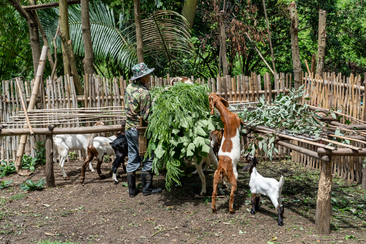
Upland farmer in Nan integrating trees, crops, bees and livestock systems

We work with the farmers to introduce understory crops, ground cover plants and complementary activities. We are experimenting with legumes for soil improvement, stingless bees for pollination and honey, and small livestock such as goats.

The aim is to move toward regenerative farming systems that rely less on external inputs and more on internal cycles. There is no fixed model for this transition. It is a process that must be adapted to the capacities, labour availability and market access of individual farmers. A key constraint is market development. Regenerative systems only become viable if farmers can sell diversified products at fair prices. But building supply chains, processing capacity and relationships with buyers requires investment beyond the scope of small projects like Trees4All.

The second direction is horizontal scaling – expanding to new landscapes. We are beginning to work in Doi Phu Kha National Park, where communities farm degraded land but lack secure tenure and are heavily restricted in how they can use the land. We want to test the idea that tree planting by smallholders in these areas can contribute to both conservation and improved livelihoods.

There is also growing interest in Trees4All from organizations working in other provinces. To support expansion, we are redesigning our app and digital platform so they can be used in different contexts. But scaling also brings new challenges, particularly around financing.

A middle model

Trees4All functions as a form of informal payments for ecosystem services, with downstream donors compensating upstream farmers for restoring tree cover in ways that increase climate resilience. But this model sits awkwardly between established categories such as formal payments for ecosystem services – for which Thailand has no regulatory framework – carbon markets and corporate social responsibility (CSR) programmes.

The most immediate constraint is financial sustainability. Trees4All operates largely on project funding. When projects end, mechanisms risk disappearing even if farmers remain committed. One of our challenges, in seeking sponsorship from the private sector, is that we are not offering carbon credits. Certification and verification are too expensive for Trees4All’s tree-planters. Trade in forest carbon credits favours large, contiguous areas and marginalizes smallholders like the farmers we want to support.

Meanwhile, relying purely on CSR programmes limits scale and sustainability. But so far, most corporate contributions treat Trees4All as CSR rather than a core investment. Shifting that perception is a major challenge.

Upland farmers in Nan

We are exploring what might be called a ‘middle model’, one that offers credible reporting and impact data without claiming carbon benefits. The question is whether companies and individuals are willing to support farmer-led ecosystem restoration for its own sake, and not only because they want to show that they are offsetting their carbon emissions. 

Beyond trees

Ultimately, Trees4All is less about planting trees than about rethinking responsibility. It uses tree planting as an entry point for encouraging farmers to think about how to replace monocropping with sustainable models that align with their capacity and needs. The project also aims to influence people and businesses downstream. Because when highland farmers clear forest, their actions are linked to consumption patterns, market structures and policy decisions far beyond their farms.

If Trees4All succeeds, it will not be because of the number of trees planted. It will be because it supported farmers to move away from fragile monocropping systems, helped corporate sponsors to see beyond carbon, and showed that sustaining forests and increasing resilience is a shared responsibility of people living both upstream and downstream.

###

Warangkana Rattanarat is country director of RECOFTC Thailand.

Story details

Geographic focus
Thailand