
On 14–15 October 2026, RECOFTC joined the Asia-Pacific Network for Sustainable Forest Management and Rehabilitation (APFNet) as a co-organizer of the 2026 ‘Workshop on forestry strategic planning in the Asia-Pacific region’ in Beijing, China. Forestry officials from across Central and South Asia, Southeast Asia and the Pacific gathered along with representatives from Mexico at APFNet’s seventh meeting of the Forest Planning Network.
News
Forestry planners discuss priorities and challenges
APFNet and RECOFTC bring forestry officials together to exchange experiences, strengthen planning and discuss primary forest conservation
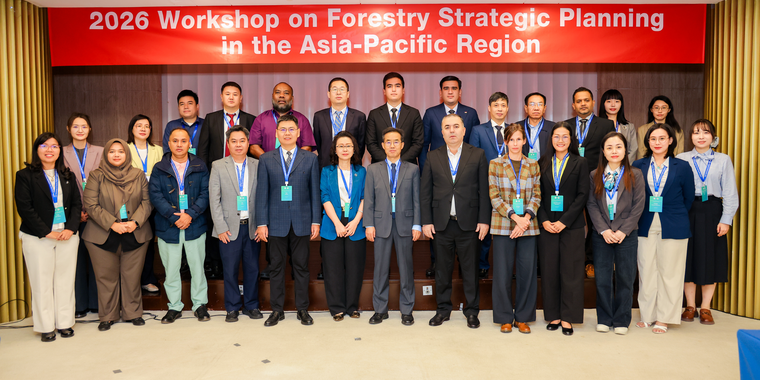
Photo by APFNet
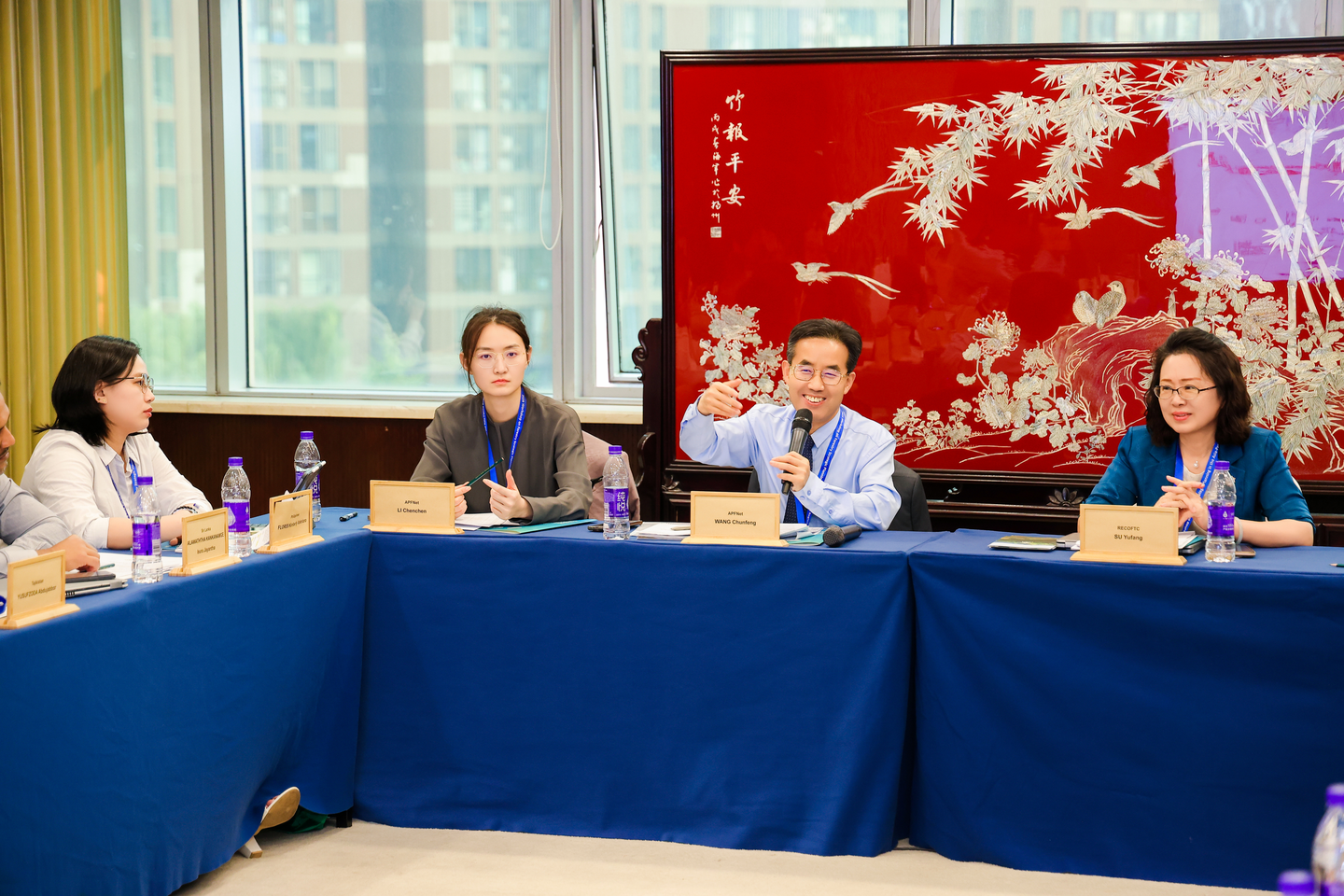
Chunfeng Wang (second from right), APFNet’s executive director and RECOFTC’s Yufang Su (far right), programme manager for Explore, delivered the opening remarks. Photo by APFNet
RECOFTC’s Yufang Su, programme manager for Explore, delivered opening remarks at the workshop alongside Chunfeng Wang, APFNet’s executive director. Wang noted that APFNet would continue to work closely with members to advance regional cooperation on forestry development. “The quality of forestry plans has direct impacts on ecological security, people’s livelihoods and sustainable development,” he said.
In her remarks, Su highlighted the value of cross-learning. “This workshop offers a valuable opportunity to share experiences, discuss common challenges and learn from one another,” she said. She also spoke about RECOFTC and APFNet’s partnership through the Southeast Asia Fire Management Mechanism (SEA-FiMM), under which a community-based fire management project is being implemented.
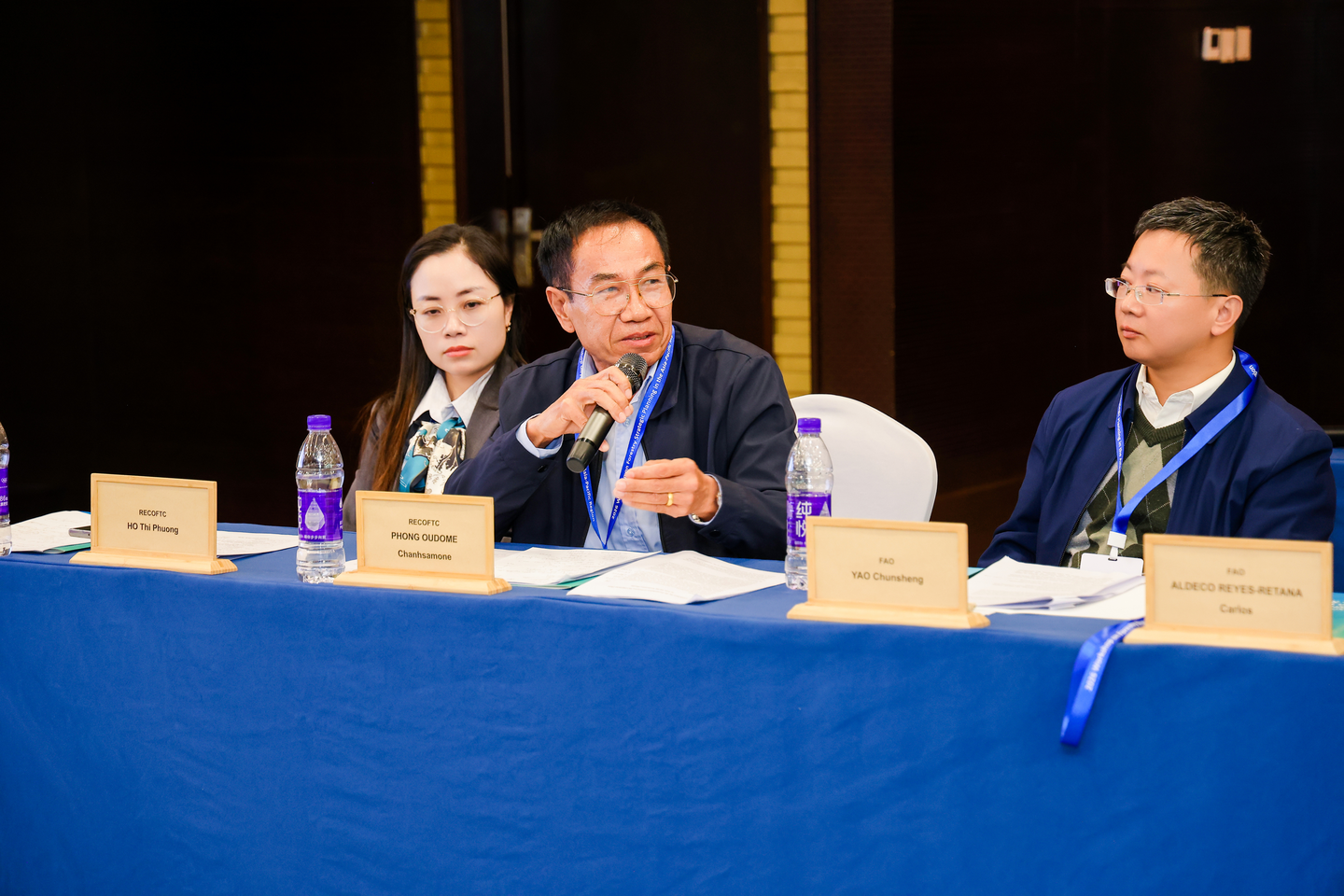
Explore researchers Ho Thi Phuong and Chanhsamone Phongoudome also joined the meeting. Their project examines how gender inequalities shape forest landscape governance and climate adaptation in Lao PDR, Myanmar and Viet Nam. Photo by APFNet
Two researchers from an Explore-supported project looking at how gender inequalities shape forest landscape governance and climate adaptation also attended the workshop. Chanhsamone Phongoudome, co-principal investigator of ongoing research in Lao PDR, Myanmar and Viet Nam, said, “This was a great opportunity to learn from the forestry planning processes of different countries.”
Advancing primary forest conservation and sustainable use
Primary forests are significant repositories of globally biodiversity, including threatened species. Faustine Zoveda, forestry officer at FAO, introduced the Southeast Asia and the Pacific Forests Integrated Program that is working on the conservation and sustainable use of primary forests in the region.
Janita Gurung, RECOFTC’s governance and rights lead, co-led the discussion which highlighted the importance of building political momentum to conserve primary forests for their biodiversity, carbon storage and livelihood values. Reflecting on the event, she noted, “Understanding the ecological, cultural and social values are an important part of achieving primary forest conservation and sustainable use.”
RECOFTC is currently supporting FAO in developing a regional ambition for the conservation and sustainable use of primary forests in Southeast Asia and the Pacific.
Sharing knowledge, progress, challenges and needs
Participants reviewed the draft Guidelines for the formulation of forestry development plans in Asia-Pacific economies. Commissioned by APFNet, the guidelines aim to provide economies with a voluntary, practical reference for forestry planning.
They also shared progress, challenges and needs in their national forestry planning processes. Common challenges included unreliable forest data, limited monitoring capacity, competing development pressures and a lack of long-term financing. They highlighted the need for better data systems, integrated landscape planning and a stronger role for local communities.
*
The Southeast Asia Fire Management Mechanism (SEA-FiMM) promotes knowledge exchange, builds capacity and supports practical approaches to wildfire prevention and response. Established by APFNet, RECOFTC and Tropenbos International to strengthen regional cooperation on fire management, it connects governments, communities, researchers and other stakeholders to develop collaborative solutions that protect people, ecosystems and the climate.
Explore is a research network and community of practice dedicated to expanding and applying knowledge on forest landscape governance in Southeast Asia. The network is funded by the Government of Sweden and hosted by RECOFTC, in partnership with the Landscape Alliance, in collaboration with universities, research institutes, governments, civil society organizations, local communities and the private sector across Southeast Asia.