
The Food and Agriculture Organization of the United Nations (FAO) and Royal Forest Department of Thailand's Asia-Pacific Forestry Week (APFW2025), held in Chiang Mai, Thailand from 4 to 7 November, brought together 150 forestry practitioners, government officials, researchers and community representatives under the theme ‘Healthy forests feed the future’.
Notes from the field
RECOFTC engagement at Asia-Pacific Forestry Week 2025
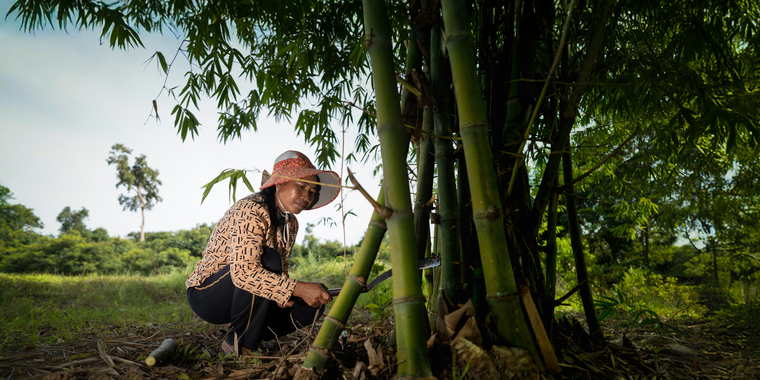
A woman harvests bamboo in Prey Hum Community Forest, Kampong Thom Province, Cambodia.
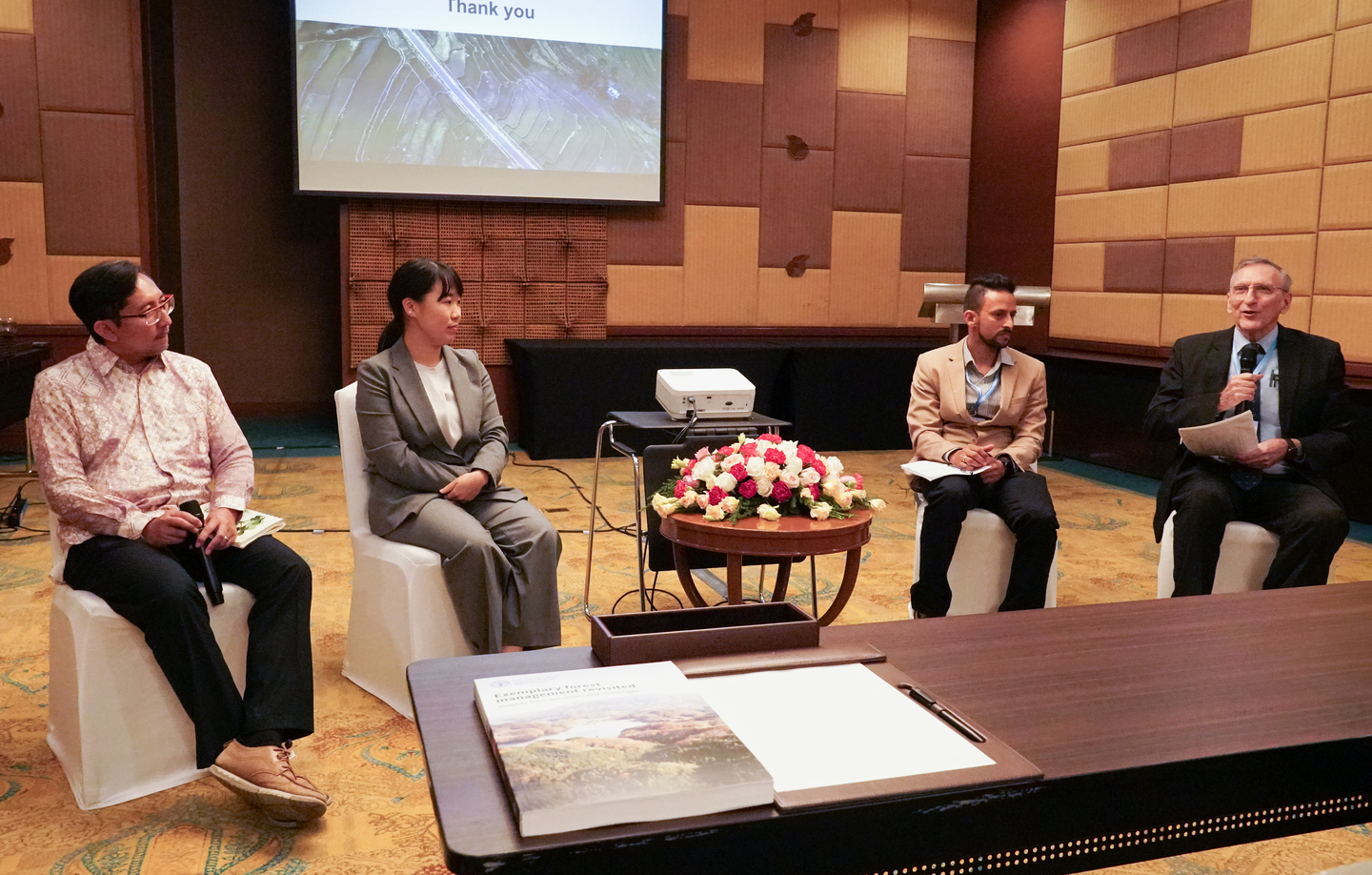
Patrick Durst (right), president at ISTF, moderates a panel discussion.
On 4 November, RECOFTC, the International Society of Tropical Foresters (ISTF) and the Wyss Academy for Nature joined FAO to co-host the session ‘Exemplary forest management revisited: Insights from successes and challenges’.
The side event examined forests changes over time and elements that contribute to sustainable, resilient forest management. Akiko Tabata from Japan’s Forestry Agency discussed how long-term lessons help shape future decisions. Kenichi Shono, forestry officer at FAO, provided a global overview and launched the publication Exemplary forest management revisited: Insights from successes and challenges.
David Ganz, RECOFTC’s executive director, shared key findings from the 11 case studies from the Asia-Pacific region included in the report. He provided an overview of the emerging trends, forest managers’ adaptive responses to challenges and enabling conditions for sustainable forests.
A panel discussion moderated by Patrick Durst, president at ISTF, highlighted three case studies – from Nepal, Indonesia and Japan. Discussions that followed reinforced a clear lesson: forests remain strong when communities have secure rights, practical skills and the flexibility to adapt over time.
Communicating change: Growing the solution

Mary Ann Llanza (second from left), RECOFTC’s director for knowledge management, IT and strategic communication, sharing communication lessons from the Trees4All project.
On 5 November, RECOFTC joined colleagues from the Forest Communicators Networks to discuss communication and its role in driving forest action. The session, ‘Communicating change: Growing the solution’, explored how clearer messages can help people understand the links between forests, food and daily life.
Ganz opened with a reminder that communication is not an add-on to technical forestry work, but part of it. “Clear and relatable messages help connect science, policy and lived experiences,” he said.
Kai Lintunen, lead of the UNECE–FAO Forest Communicators Network, delivered the keynote showcasing the ‘Grow the solution’ initiative. The campaign stresses how everyday choices, such as selecting certified timber, contribute to broader climate and sustainability goals. “Effective campaigns make these connections visible, linking forest management to daily life and modern bio-economies.”
Marianela Argüello, lead of the Forest Communicators Network for Latin America and the Caribbean, discussed how communicators are experimenting with a range of AI and automation tools for content creation and workflow automation. “This has enabled new efficiencies and improvements to deliver better-targeted messages to public audiences and foster more engaging communication,” she said.
Mary Ann Llanza, RECOFTC’s director of knowledge management, IT and strategic communication, shared lessons from Trees4All. The project’s communication approach has reached urban audiences in Thailand through engaging visuals, simple language and authentic stories from farmers, and has been crucial in building farmers’ ownership, showcasing transparency and raising funds.
Paula Sarigumba, communications and outreach officer at International Tropical Timber Organization (ITTO), shared her experiences working to make forest science relatable for young people. "By translating complex topics into clear and meaningful messages, we help youth understand the vital role tropical forests play in their daily lives," she said.
Speakers agreed that people act for forests when they connect with the story. For RECOFTC, strengthening community rights also means amplifying their voices.
Advancing fire-resilient forest landscapes

Janita Gurung, RECOFTC programme lead for improved governance and respect for rights, moderating the ‘Fireside chat’ side event.
On 7 November, RECOFTC, APFNet and ITTO co-hosted ‘Igniting change in Asia-Pacific: Food security through collaborations on community-based fire management’. RECOFTC brought experts together to highlight fire as a critical ecological and social challenge locally and across the region, emphasizing its links to food security, climate and biodiversity.
Read a detailed account of the event here.
Social forestry for food security and climate action

David Ganz (second from left), RECOFTC’s executive director, speaks at the ASEAN Working Group on Social Forestry and FAO-led session on Social forestry in Southeast Asia: Food security and climate action on 7 November.
Also on 7 November, RECOFTC joined the ASEAN Working Group on Social Forestry and FAO in the session on Social forestry in Southeast Asia: Food security and climate action, highlighting how community forestry contributes to food systems and climate resilience.
RECOFTC’s presentation focused on our experience securing investment for inclusive and equitable social forestry. We have consistently seen that empowering women, youth and marginalized groups improves governance, strengthens benefit-sharing and supports community-led action on climate and biodiversity.
Momentum for investment is growing through REDD+, green value chains and blended finance although challenges such as tenure insecurity, unclear regulations and limited market readiness remain. Strengthening enabling policies, expanding community finance and improving enterprise capacity are essential steps for the region.
A space for stories and ideas

APFW participants and RECOFTC staff at the RECOFTC booth.
All our interventions at APFW2025 reaffirmed the message that empowered communities are essential to healthy forests and healthy futures. Throughout the week, RECOFTC’s exhibition booth also provided a space for conversation. Visitors explored practical manuals, youth-focused materials and community stories from across the region.
The Government of Bhutan will host the next Asia-Pacific Forestry Week in 2027, providing another important platform for regional collaboration and shared learning.
##
Utsav Maden is communication and knowledge management officer at RECOFTC.
Story details
Thematic area
Climate change
Economic benefits for communities
Gender equality and social inclusion
Governance and rights
Geographic focus
Regional