
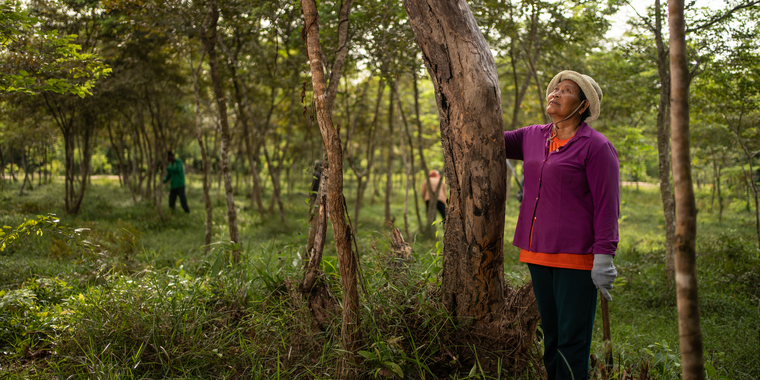
Indigenous Peoples and local communities were front and centre at this year’s climate Conference of Parties (COP 30). The participation of Indigenous Peoples and local communities surpassed any previous COP with some 3,000 Indigenous individuals joining from around the world.
There was also the landmark adoption of the Intergovernmental Land Tenure Commitment (ILTC), recognizing land tenure rights for Indigenous Peoples, local communities and Afro-descendant populations. There is now a commitment to collectively recognize and strengthen 160 million hectares of Indigenous Peoples and local community lands by 2030.
Taken together, these developments reflect growing awareness around the essential role of Indigenous Peoples and local communities in forest protection and efforts to tackle the climate crisis. This reinforces a hard lesson learned by carbon markets over the past several years—ignoring local communities comes at a high cost.
A crisis of confidence
In 2024, global carbon markets faced a significant crisis of confidence. Once hailed as a revolutionary solution to climate change, the market’s credibility began to erode to the point where late-night TV hosts joked about carbon offsets.
This scepticism is rooted in doubts about whether carbon credits truly represent real and lasting emission reductions. And it is fuelled by troubling stories from the ground—accounts of communities displaced by opportunistic intermediaries or ‘carbon cowboys’, Indigenous rights signed away for a fraction of the profits, and projects that failed to deliver promised benefits.
Communities being sidelined is one of the most potent threats to the future of global carbon markets. In response, the industry has begun a much-needed course correction. The Integrity Council for the Voluntary Carbon Market (ICVCM), which is the emerging standard-bearer for global carbon credit integrity, has placed social integrity at the heart of its agenda.
Advisory groups of Indigenous Peoples and local communities are now influencing the design of carbon standards and monitoring frameworks. Across the sector, expectations are rising for how projects engage with, and are accountable to, the people who live in and depend on these landscapes.
This shift offers a lesson that extends beyond carbon markets. Other land-use sectors, from mining and hydropower to infrastructure and agribusiness, would do well to learn from it. Building genuine partnerships with Indigenous Peoples and local communities reduces social and operational risks while laying the foundation for long-term sustainability. In short, it’s not just good ethics, it’s good business.
A growing legal mandate
Any organization seeking to work in complex landscapes must begin with a clear understanding of local land rights, governance structures and potential project impacts.
In the ASEAN region, all member states are signatories to the United Nations Declaration on the Rights of Indigenous Peoples, even if implementation varies widely in practice. This provides a shared legal and moral foundation to ensure that Indigenous and local communities are systematically consulted and their rights respected.
Momentum for embedding these rights into national law is growing. Lao PDR has incorporated free, prior and informed consent (FPIC) principles into its protected area and land-use policies. The Philippines enforces strong FPIC requirements for activities on Indigenous lands. In Malaysia, FPIC is integrated into both constitutional and state-level law. In neighbouring South Asia, Nepal has adopted a national legislation on FPIC.
These examples signal a larger regional trend towards stronger social safeguards, although much remains to be done to make them effective on the ground.
Moving beyond the checklist
Even with laws and safeguards in place, ensuring meaningful participation is rarely straightforward. FPIC requires that communities make decisions according to their own customs and governance systems. In certain instances, this means relying on established local administrative frameworks such as village committees. In others, decision-making adheres to traditional institutions that may not always be inclusive of women or youth. Each community tends to adopt its own approach, making it difficult to standardize or scale engagement across broader landscapes.
It becomes even more complex deepens in the context of emerging climate finance mechanisms such as the United Nations Collaborative Programme on Reducing Emissions from Deforestation and Forest Degradation (REDD+), which encompass large-scale programmes to reduce emissions through forest conservation. The sub-national governments often tasked with implementing safeguards may lack the resources, training or institutional capacity needed to ensure high-quality consultation and oversight. Without strong local governance and understanding, well-intentioned projects risk failing to meet social and ethical standards.
Meaningful engagement cannot be achieved through checklists and token consultations. It demands investment – in time, in capacity building and in the training of facilitators who can bridge cultural, linguistic and political divides. Land-use initiatives that ignore social safeguards routinely fall short of their goals. By contrast, projects that secure the trust and participation of local people enjoy greater legitimacy, stability and long-term success.
Ultimately, there is no trade-off between rights and results. The ethical path – respecting the voices and rights of those who live on the land – is the only logical path to sustainable and resilient landscape management in the ASEAN region. Anything less is built on borrowed time.
###
Regan Pairojmahakij is the Climate Change Programme Lead at RECOFTC.