
Menu
Stories
In focus

Strengthening engagement of Indigenous Peoples and local communities on jurisdictional forest carbon finance

Indigenous Peoples and local communities - Viet Nam

In coordination with local partners, RECOFTC Viet Nam has been organizing a series of activities in Lam Dong province to strengthen the capacities of Indigenous Peoples and local communities. 

These events have been organized within the framework of the Kawari-funded ‘Supporting Indigenous Peoples and local communities in Lao PDR and Viet Nam to advance their rights through jurisdictional forest carbon initiatives’ project. 

Specifically, our activities are designed to improve the capacity of Indigenous Peoples and local communities to participate in the Lowering Emissions by Accelerating Forest Finance (LEAF) programme in Vet Nam. This is an initiative to reduce emissions from forests in the Central Highlands and South Central Coast. 

Speaking of his community’s engagement with LEAF, Y Pam Ayun, a villager from Cho Rung in Lam Dong’s Ta Nang commune says, “We now have a better understanding of our responsibilities and rights. And we’re more confident when participating in forest carbon initiatives because we know which agency to contact when we need information.”

Engaging at the village, province and regional levels

As we work to equip Indigenous Peoples and local communities with basic knowledge about climate change and forest carbon, it becomes integral to also build knowledge of free, prior and informed consent (FPIC) principles.

Our work focuses on disseminating knowledge and information on benefit-sharing mechanisms; social and environmental safeguards; and grievance redressal mechanisms. A core focus is on ensuring that Indigenous Peoples and local communities are provided necessary information about their roles and responsibilities and the benefits they are entitled to when they participate in the LEAF programme.

So far, we have organized nine village-level meetings in four villages in Da Quyn commune (former Duc Trong district). Cumulatively, 284 people participated in these meetings. We also organized three province-level meetings with 111 delegates, including representatives from Indigenous Peoples’ groups, local communities, authorities, professional agencies and international partners.

In April 2025, we also organized a regional workshop in Bangkok, Thailand with delegates from both Viet Nam and Lao PDR. The workshop helped share experiences and identify common challenges. It also generated recommendations to increase transparency, reinvest carbon credit proceeds into livelihoods and further strengthen engagement with Indigenous Peoples and local communities.

Community voices and collaboration with agencies

Many individuals from Indigenous Peoples’ groups and local communities, especially women, have become more confident in speaking up and sharing the results of group discussions at provincial and regional meetings. Women and individuals from disadvantaged groups have also reported receiving support and encouragement to participate.

The head of Tan Ha village in Ta Nang commune, Cil K’Hanh, says her community now has a clear understanding of their roles and responsibilities in preventing forest fire to help store carbon in forests. As someone who has participated in many meetings at the local, commune and province levels, she adds, “I’ve learnt a lot about working in groups and respecting everyone's opinions.”

Ka Sa K’Uy, from Cho Re village in Ta Nang says, “I now know that forests not only support local livelihoods but also contribute to reducing climate change. And I have the confidence to share my opinions, even in large groups.”

Participants interact with each other during a provincial meeting held in Dat Lat city
Participants interact with each other during a provincial meeting held in Dat Lat city on 18 August 2025

Community participation and lessons for the future

Our work is helping local authorities and relevant agencies better understand the importance of meaningful community engagement in Jurisdictional REDD (JREDD), the LEAF programme that Lam Dong participates in.

The participation of Indigenous Peoples and local communities is essential for the success of forest emission reduction initiatives. At a recent event, Le Van Trung, a representative of the Department of Agriculture and Environment, Lam Dong province, noted how community engagement is “convincing proof of the success of RECOFTC’s efforts”. He remarked that being part of our project had had a visible impact on community members, especially women from minority ethnic groups. “Community members who were shy and lacking in confidence, are now able to speak confidently in front of an audience,” he said. “It is impressive that they can already speak about new and technical issues such as forest carbon. This is an outstanding achievement, and we hope RECOFTC will continue to accompany us to train more people.”

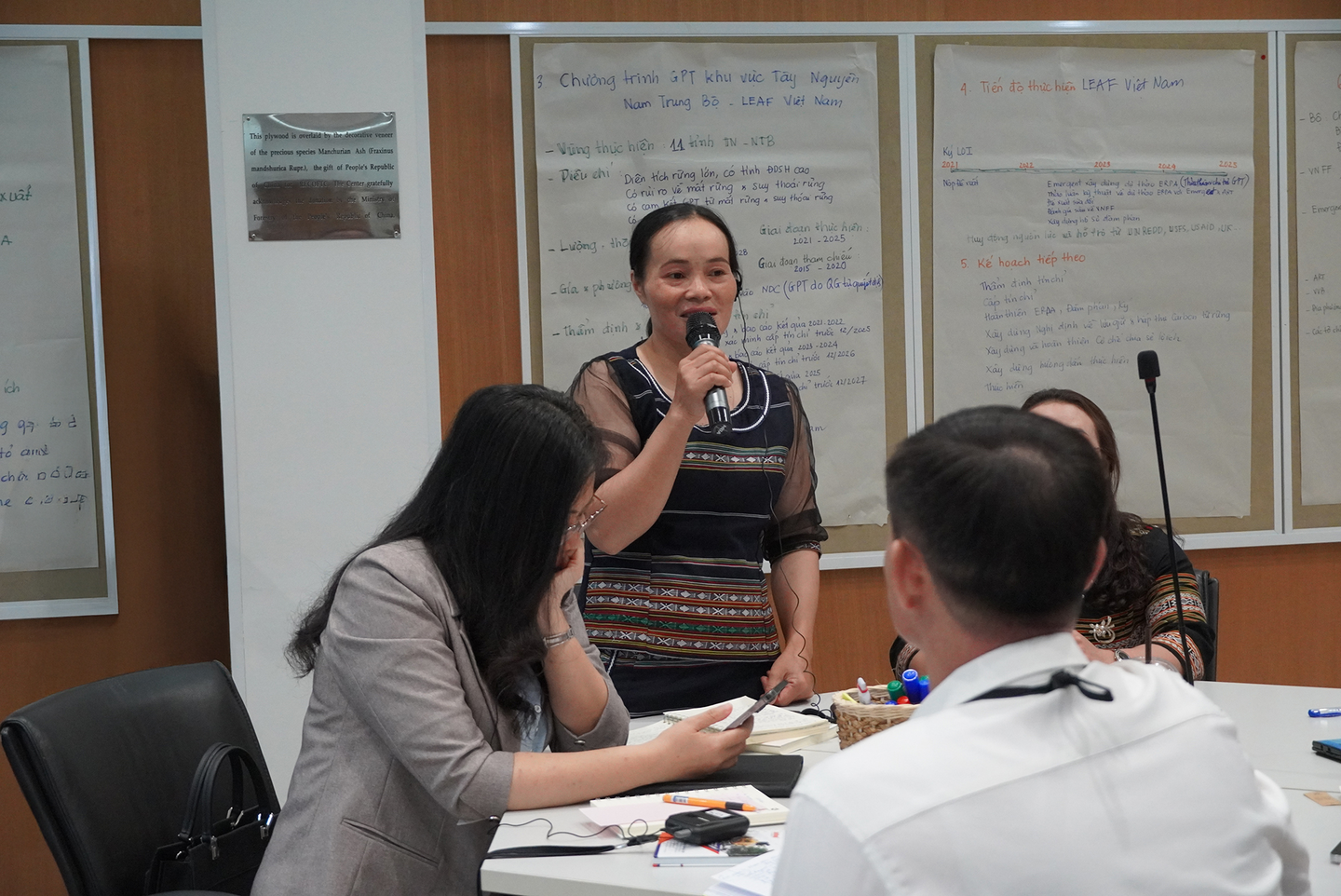
A group discussion on strengthening engagement of Indigenous Peoples and local communities in jurisdictional forest carbon finance.
Participants share their views during a provincial meeting in Da Lat City on 18 August 2025

RECOFTC Viet Nam and our stakeholders recognize the need to expand our activities to other provinces participating in LEAF. There is an urgent need to develop bilingual documents in Vietnamese and local dialects for community members. We also need to develop training-of-trainer documents for core groups of Indigenous Peoples and local communities to disseminate information within communities.

Ensuring regular dialogue mechanisms between Indigenous Peoples, local communities and government authorities at all levels is also essential. For Indigenous Peoples and local communities to effectively and meaningfully participate, we need greater information-sharing and capacity-building initiatives.

Projects like ours are prerequisites to helping communities gain the understanding and capacity needed to participate in consultation activities led by government agencies. We will continue to provide the technical support needed to develop the knowledge and participation of Indigenous Peoples and local communities and strengthen connectivity among Vietnamese and Lao communities. It is crucial that we establish platforms to share experiences, learn from each other and unite around similar goals.

***

Nguyen Chien Cuong and Nguyen Thi Thuy are programme coordinators at RECOFTC Viet Nam. 

The Kawari-funded ‘Supporting Indigenous Peoples and local communities in Lao PDR and Viet Nam to advance their rights through jurisdictional forest carbon initiatives’ project is implemented by RECOFTC. The project aims to strengthen the capacity of Indigenous Peoples and local communities at the grassroots level to ensure their active engagement in the design and implementation of the Lowering Emissions by Accelerating Forest Finance (LEAF) programme.

Story details

Geographic focus
Viet Nam