
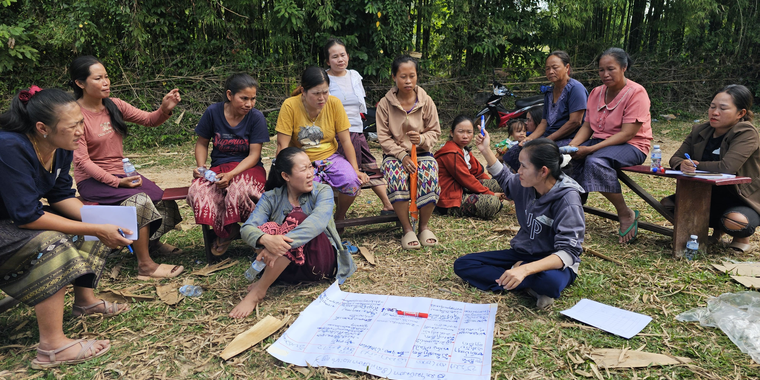
In Lao PDR, land and forestry planning are male-dominated domains. Historically, these fields were deemed “too demanding” for women, and although things are changing, women’s access to strategic and decision-making positions remains limited.
Gender mainstreaming efforts
When it comes to forest management planning, women are gravely underrepresented in technical and leadership positions, including process planning, mapping and decision-making roles. Data from the Department of Forestry (DoF) and the Department of Forest Inspection highlight the gaps, where women make up only about 10 per cent of foresters in Lao PDR. In decision making positions, women’s involvement is even lower, at just five percent.
Recognizing the need to integrate gender equality across the forestry sector, the Ministry of Agriculture and Forestry has mainstreamed gender into 11 work plans and 46 projects. The goal is to strengthen mechanisms and capacity-building programmes for women and local communities, particularly in rural areas with limited opportunities.
The government’s efforts aim to ensure women’s participation in decision-making and policy formulation at all levels, with at least 20 percent representation in leadership roles.
RECOFTC’s role
Through the Mekong Region Land Governance project, we supported the integration of gender equality into technical processes together with Village Focus International (VFI), the Lao Women’s Union, the Department of Forestry, the Department of Land and the Department of Agriculture Land Management.
We helped build the capacity of technical staff and developed training materials for teams working on land and forest use planning at both national and local levels. Additionally, we introduced a checklist aligned with the government’s Procedural Guidelines on Participatory Land Tenure Recognition in Forestland to embed gender sensitivity into forestland tenure recognition.
Our training materials integrate gender considerations into planning processes and provide guidance on promoting land rights and gender equality in alignment with national policies and legal frameworks. The related tools help assess participation and ensure gender equality through various stages of implementation.
Sonephet Xaysombath, a technical administrative staff at the Xaybouathong District Agriculture and Forestry Office, notes that she is grateful for the trainings that have strengthened her capacity in gender mainstreaming. “These efforts help ensure recognition of women’s roles in technical forestry,” she says. “I hope to see the progress we’re making here replicated in other areas."
