
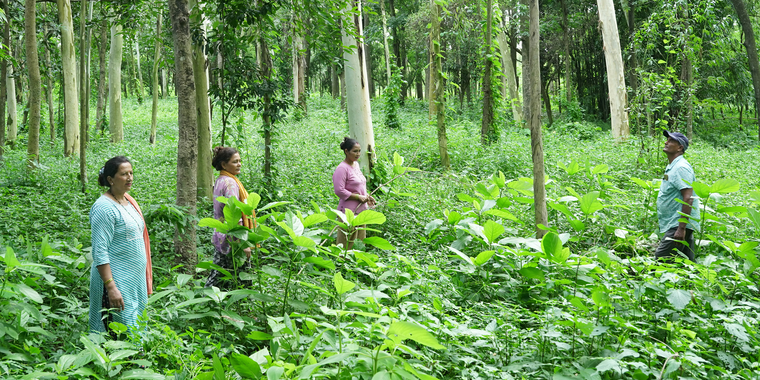
Nepal’s community forestry programme, which enabled thousands of empowered communities to transform degraded landscapes into forests, is at a critical turning point.
When community forestry began – initially in the late 1970s and then systematically from the 1990s – Nepal’s forests were in a desperate condition. Forest loss and degradation were widespread due to poor governance and mismanagement.
Over the decades, the ecological, social, economic and political contexts have changed considerably. In the 1960s, forests covered nearly half of the country, but by 1992 their extent had fallen to just 26 per cent.
The Forest Act 1993 was a turning point. It gave communities collective rights to manage local forests. By 2016, forest cover had increased to 45 per cent, with communities protecting, replanting and managing nearly three million hectares that the state could not manage on its own.
Today, there are more than 23,000 community forest user groups (CFUGs) across Nepal. There is local leadership, there are provisions for fair use of resources, and women have gained visibility and authority.
Changing forests, new needs
This success has brought new needs. There are now mature trees in many community forests, which need to be harvested. Unfortunately, administrative and regulatory hurdles make it difficult for communities to harvest and transport timber.
Furthermore, many CFUGs have been unable to renew their operational plans because they are waiting for technical support from division forest offices. Until the backlog is cleared, such CFUGs lack the legal documents needed to manage their community forests, including legally harvesting forest products.
Another challenge is that many community forests are small. It is simply not economical for their CFUGs to produce forest products as they cannot cover their management costs. And when communities cannot benefit from timber and access the economic potential of the forests they have restored, their enthusiasm naturally declines.
Demographic change is also another factor. Across Nepal, many young people are leaving villages to work in urban centres within and outside the country. The shrinking and ageing rural workforce is less enthusiastic today about the demanding work of managing forests.
Rural communities are also growing less dependent on forests. Many receive remittance from abroad, no longer use fuelwood stoves and do not keep livestock that require fodder from the forest.
And while there are some examples of self-sufficient CFUGs in the Terai plains, the overall picture is mixed. Some CFUGs no longer hold their annual assemblies. Others are dysfunctional because members no longer live in the village.
Hope and confusion
When Nepal shifted to a federal governance system in 2015, community forestry – previously governed by the national forest ministry – came under three layers of administration: national, provincial and local.
In theory, this should have made governance more efficient and responsive, granting community forest user groups closer access to decision-makers. However, conflicting and confusing policies outweigh the gains. Different levels of government interpret laws and taxation powers differently. In some cases, policies also vary from province to province. CFUGs are caught in the middle, confused about their roles, relationships and relevance.
Another major shift is financial. During the expansion of community forestry, donor agencies provided significant support for facilitation, training, piloting new models and documenting lessons. That flow of funding has since shrunk. Today, bilateral support for community forestry is almost non-existent.
While some CFUGs generate enough income to be able to invest in good management, many others do not. This creates the risk of some community forests succeeding while others decline, increasingly inequality in a system that was meant to empower all.
There are some hopes that markets for carbon and biodiversity credits could help to plug the finance gap as a co-benefit. Currently, several carbon projects are in development. And in November 2025, Nepal received its first payment of USD 9.4 million from the World Bank’s Forest Carbon Partnership Facility. However, important questions remain unanswered. How predictable and simple will benefit distribution be? Will the benefits motivate continued forest management?
Need for dialogue and a path forward
Nepal’s community forestry programme has not kept pace with changing realities. Some critics say CFUGs have become politicized or unproductive. Some community voices argue that the government wants to take back control. The Federation of Community Forestry Users Nepal (FECOFUN) pushes hard to defend rights. And government officials operate under constraints and confusions of their own.
Too often, this becomes a blame game. But blame does not move us forward. It is time for all key actors – government agencies at every level, communities, FECOFUN, the private sector, academia and civil society – to come together and speak openly about what is working and what is not.
Youth must be brought into the fold. They are key to the evolution of community forestry, bringing fresh energy, digital literacy, entrepreneurial thinking and new networks into the sector.
If young people can imagine a future in the forest economy, one that supports prosperity at home, they may choose to stay, return or invest. For this, they must be given opportunities to co-create business models, whether that be in timber, ecotourism or other goods and services that forests provide.
This is perhaps, the most critical challenge, because without a new generation of people to manage the country’s community forests, the alternatives are either privatization or a return to state control. And the government cannot manage Nepal’s forests alone. Communities remain central to the country’s environmental future.
The first generation of community forestry achieved remarkable things – forest recovery, social inclusion and community empowerment. But now we must build a second generation, Community Forestry 2.0.
We don’t know yet what that will look like. But we know that it requires clarity in law and governance, improved economic incentives, active roles for youth, collaboration among stakeholders and renewed investment in capacity and learning.
###
Sudha Khadka is country director at RECOFTC Nepal.