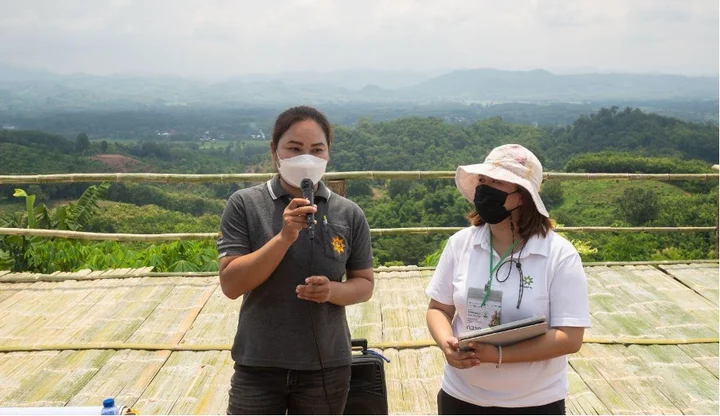


Atop a steep hill in Santisuk District of Nan Province, 26-year-old farmer Wararat Wutti is planting native tree species with a group of volunteers who have come a long way from Bangkok and other provinces.
Wutti inherited the 3 hectares of land from her parents. For decades, her family grew monocultured maize. Monoculture means growing just one crop in an area of land. Ultimately, the growing of monocultured maize degraded the land. Severe drought and high temperatures induced by deforestation and climate change also caused fires that ravaged the farmland twice over the past few years.
Wutti thinks it’s time to bring fertility back to this land, not only for the sake of the environment but for her to generate income from it in a more sustainable way.
She decided to join Trees4All, which is a tree-planting initiative co-created and co-managed by the Rak Santisuk Community Financial Institute and RECOFTC.
Why Nan?
Located nearly 700 kilometres north of Thailand’s capital, Bangkok, Nan Province is home to a forest ecosystem of vital importance to the country’s largest watershed, the Chao Phraya River. Around 40 percent of water in the Chao Phraya comes from the Nan River.
But more than 160,000 hectares of forest in Nan have been degraded, primarily by the vast expansion of monoculture maize plantations over the past three decades. The massive loss of forests threatens the quantity and quality of water in the Nan and Chao Phraya rivers.
The government began to promote maize cultivation in the 1980s in light of rising demand and prices. The cash crop boom led to the conversion of vast forested areas into maize plantations. It also pushed farmers into a debt trap because of the fluctuating price of maize, the rising cost of farm inputs and unfair contract farming agreements.
Nan Deputy Governor Kritpetch Petcharaburanin believes that by planting native tree species in the monoculture plantations, Trees4All will help restore the ecosystem and improve farmers’ livelihoods.
“In the past, we followed the economic development path,” says Petcharaburanin. “From now on, Nan people will be the guardians of the Nan and Chao Phraya watersheds.”
The pioneers
The Trees4All is designed to support farmers who grow monocultures and have been granted land-use permits to live or cultivate in degraded forest and watershed areas. Permission includes a land document issued by the government’s National Land Policy Committee, known as Kor Tor Chor.
Following interviews with interested farmers and inspection of their farmlands, the first 17 farmers were selected by Trees4All to join the initiative. They had been growing maize, rubber, cacao and avocado as monocultures.
At the peak of the rainy season in August 2022, the farmers began planting native tree species on their farmlands where they had previously harvested their monocultured crops.
Some farmers chose to plant Dipterocarpaceae tree species, which create conditions for mushrooms to grow. Other farmers preferred herbal, native fruit and timber trees.