
Menu
Conference

Community-based fire management session at the Global Fire Management Hub Plenary

Co-organized by RECOFTC, this session highlights community-based fire management as a critical component of Integrated Fire Management, especially in fire-prone landscapes shaped by traditional land use, socio-ecological systems and climate variability.
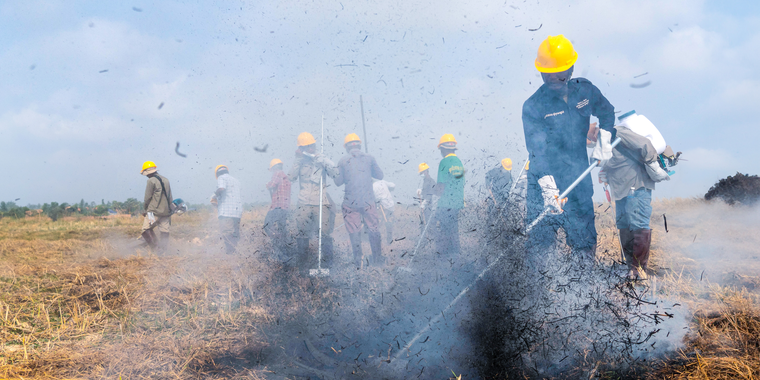
CBFiM field training on fire management practices

Community-based fire management (CBFiM) is increasingly recognized as a vital approach for addressing the growing complexity of wildfire risk, especially in landscapes shaped by diverse socio-ecological dynamics, traditional land-use practices and climate variability. Rooted in participatory governance, tenure security and local knowledge systems, CBFiM enables local communities to be proactive agents in fire prevention, preparedness, response and recovery. 

Despite mounting evidence of its effectiveness, CBFiM remains insufficiently embedded in national policies and international climate commitments. Barriers such as inadequate recognition of customary institutions and rights, limited access to resources and fragmented governance frameworks impede the institutionalization and scalability of CBFiM approaches. 

Co-hosted by RECOFTC, Tropenbos International and the Food and Agriculture Organization of the United Nations (FAO), this plenary session will amplify the voices of Indigenous Peoples, local communities and other underrepresented actors at the forefront of fire management.


Timezone
CEST
Time [CEST] Session details
11:00 – 11:12 - CEST

Introduction: Community roundtable and global fire dialogues

Set the stage for the session, introduce the theme and relevance of community-based fire management within the Integrated Fire Management and the Fire Hub.

Moderated discussion:

  • Marina Tornorsam, RECOFTC: What is community-based fire management? Why it is relevant? How does it fit within integrated fire management?
  • Rosalien Jeezer, Tropenbos International: Overview of the global fire dialogues and regional engagement
11:12 – 11:30 - CEST

Regional perspectives

Highlight diverse community experiences and insights from Southeast Asia, Amazon and Africa.

Facilitator: Val Charlton, EU FIRE-RES project advisor

Speakers:

  • Southeast Asia Fire Dialogue outcomes, Ms. Chinda Milayvong, RECOFTC Lao PDR
  • Community fire monitoring and response, Mr. Wilver Arezabi Abay, Tropenbos Bolivia
  • African community experiences, Mr. Behayo Kelson, Tropenbos Uganda 
11:30-11:50 - CEST

Panel discussion: Lessons and challenges 

Extract key learnings from regional dialogues

Facilitator: Val Charlton, EU FIRE-RES project advisor 

11:50-12:00 - CEST

Q&A

Facilitator: Val Charlton, EU FIRE-RES project advisor 

12:00-12:10 - CEST

Reflections: Vision for the future

Community voices on CBFiM’s role in building climate resilience

Moderator: Rosalien Jeezer, Tropenbos International

12:10-12:30 - CEST

Roadmap for community-based fire management and working group launch

Moderator: Marina Tornorsam, RECOFTC

Speakers: 

David Ganz, RECOFTC

  • Overview of community-based fire management: origins, early adoption and evolution into a global practice
  • Development of community-based fire management guidelines 

Lara Steil, FAO

  • Community-based fire management as a foundational pillar of the FAO Fire Hub
  • Introduction to the community-based fire management working group
     
Time [CEST] Session details
11:00-12:30 - CEST

Capacity Building is one of the five pillars of the Fire Hub. It aims to understand the needs of countries and support them in implementing integrated fire management.


Under the capacity building (CB) pillar, Fire Hub partners work together to deliver their own capacity building programmes into a targeted and streamlined package of support that meets country needs. Bringing partners together to coordinate the delivery of their country support programs ensures efficiency, maximizes comparative advantage and avoids duplication or overlap.


The session will present what capacity building is, good examples and the IFM Voluntary Assessment Tool initiative. It will conclude with a discussion on the past, present and future of capacity building.

Speakers:

  • Justin Chisenga, Capacity Development Officer, FAO
  • Bill de Groot, Fire Management Expert, FAO
  • Mehmet Ozen, Forest Fires and Research Chief Engineer, Western Mediterranean Forestry Research Institute Directorate, General Directorate of Forestry, Türkiye
  • Andrey Eritsov, Director, Aerial & Ground Forest Fire Management Center, Khanty-Mansisk, Russia
  • Marina Tornorsam, Regional Project Manager, Community-based Fire Management in Asia, RECOFTC
  • Francisco Torres, Resilient Landscape Project Manager , The Nature Conservancy
  • Nuria Prat, Head of the Knowledge and Applied Science Area, Pau Costa Foundation
  • Edith Cottebrune-Merillon, Senior Policy Expert, FAO

Expected outcomes

  • Increased visibility of local voices and traditional knowledge
  • Greater recognition of community-based fire management effectiveness among policymakers and practitioners
  • Strengthened networks and collaboration for community-based fire management
  • Identification of opportunities for sustainable financing and support
  • Recommendations for integrating community-based fire management into policies and climate commitments

Expected participants

  • Indigenous Peoples, local communities and community organizations
  • Policymakers and government officials
  • Fire management and climate resilience practitioners
  • Researchers and technical experts
  • International organizations and regional networks
  • Donors, development partners and NGOs
  • Private sector stakeholders
  • Media

About the Global Fire Management Hub Plenary 

The Global Fire Management Hub Plenary, taking place from 10 to 12 June 2025 at FAO Headquarters in Rome, Italy, marks the first global gathering of the Fire Hub community, uniting experts, practitioners, policymakers and community representatives from around the world. Participants will collaborate to advance Integrated Fire Management, exchange knowledge and co-develop strategies for wildfire resilience. Across three days, the event will foster connections, inspire innovation and build partnerships to strengthen fire management at all levels. 

Click to learn more 

Join the webcast here 

Register to join online