
This project aims to develop sustainable business models in Myanmar and Viet Nam, addressing environmental degradation through nature-positive restoration.
Change beyond supply chains, driving positive landscape transformation through inclusive business models

Ongoing project
This project is developing sustainable business models for landscape restoration in Myanmar and Viet Nam by partnering with Indigenous communities. The initiative promotes a nature-positive approach that integrates increasing species diversity in former monoculture farms with transitioning farming practices toward environmental conservation. It also focuses on enhancing the sustainability of local products, supporting ecosystem health and community livelihoods.
Two landscapes where communities are facing environmental degradation and economic hardship
In Myanmar’s Inle Lake watershed, the livelihoods of ethnic communities depend largely on the sale of cheroot leaves. This crop requires significant amounts of fuelwood for drying, yet provides low income compared to other perennial crops. Ongoing deforestation has led to soil erosion, water pollution and biodiversity loss. While communities are interested in transitioning to avocado farming, which offers better economic prospects, they face challenges in accessing markets and adopting regenerative farming practices.
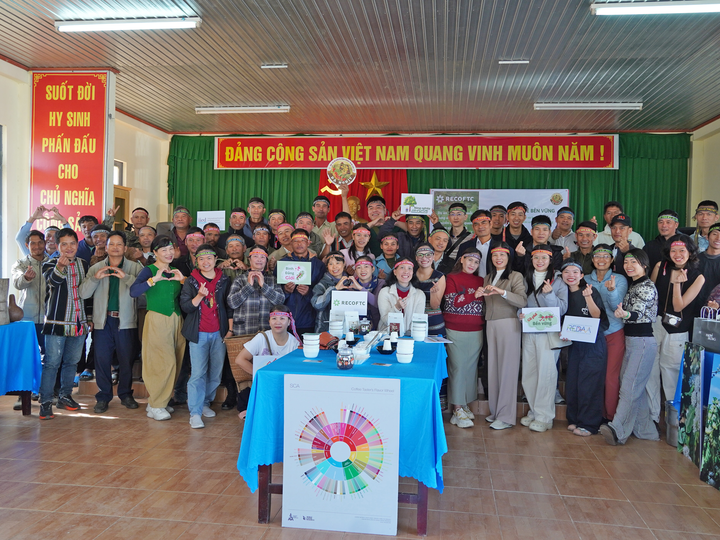
In Viet Nam, the K’Ho and Cil people in Lạc Dương district of Lâm Đồng Province are primarily smallholder farmers who rely on monoculture coffee as their main source of income. Their current farming practices depend heavily on chemical fertilizers and pesticides. Because these farms are situated on steep, sloping land, such practices have accelerated soil degradation, reduced coffee yields and disrupted the local environment.
Ethnic minority coffee producers often face price gouging at local markets and are forced to sell their products at prices that are too low. Many smallholders lack awareness of alternative, sustainable farming practices, as well as the technical skills, capital and capacity needed to invest in improvements or secure fair-trade opportunities. These communities require support to adopt more environmentally friendly practices and to strengthen their ability to trade coffee products fairly and profitably.
New business models balance nature and livelihoods
This project offers an alternative to unsustainable agricultural practices by developing business models that protect ecosystems while improving community livelihoods. Using a research-to-action approach, stakeholders will investigate the underlying causes of landscape degradation, generate evidence on sustainable alternatives and identify innovative business models.
The project aims to create inclusive and sustainable business models for landscape restoration through three main outcomes:
- Generate research on the impacts of current agricultural practices, identify potential solutions, and foster collaboration among diverse stakeholders.
- Use research findings and partnerships to design new business models based on regenerative agriculture, ensuring a balance between ecological health and economic development.
- Develop a locally led monitoring system to track and evaluate the implementation and effectiveness of these new models.

This project is part of the Reversing Environmental Degradation in Africa and Asia (REDAA) programme, which supports locally led research and action for nature restoration and climate resilience across Africa and Asia. The REDAA programme is funded by UK International Development from the UK’s Foreign, Commonwealth and Development Office (FCDO) and is managed by the International Institute for Environment and Development (IIED).
Project details
Duration
01 Mar 2024 - 28 Feb 2027
Location
Myanmar
Viet Nam
Donors
International Institute for Environment and Development