
A forest-based enterprise is linking livelihoods and mangrove conservation in Myanmar's Ayeyarwady Delta
In Pyapon township, along the fertile deltas where the Ayeyarwady River meets the Andaman Sea, dense mangrove forests shape everyday life. They provide food, fuel, shelter and a source of livelihood for local communities.
Five community forest user groups are now developing mud crab farming as a forest-based enterprise. The initiative builds on local knowledge, requires no forest clearing and offers communities a way to earn income from healthy mangrove ecosystems.
Fishing has long been central to livelihoods here. But as more mangrove areas have been cleared for paddy cultivation and fuelwood, forests have gradually declined, contributing to saltwater intrusion and falling fish stocks.
With limited opportunities to diversify income during the agricultural off-season, communities have been looking for livelihood options that work with, rather than against, the forest.
From local knowledge to a forest enterprise
Through our Community Forest Certification (CFC) project, RECOFTC partnered with five community forest user groups in 2024 to strengthen community governance and revise their forest management plans.
Following a feasibility assessment and community consultations, mud crab farming emerged as the strongest livelihood option because it builds on existing community knowledge, suits local ecological conditions and responds to demand.
The enterprise was formally incorporated into the groups' forest management plans, linking livelihood development with the long-term management of mangrove forests.
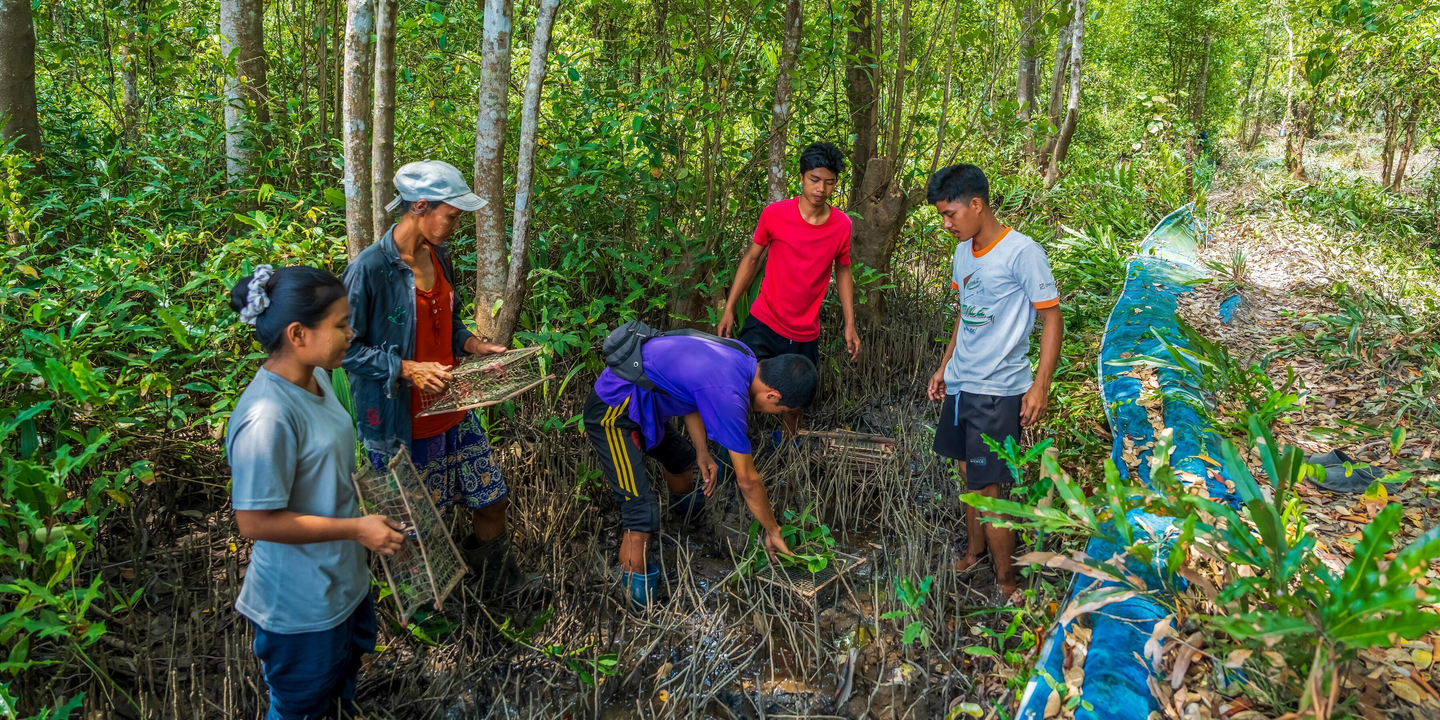
Community members established mud crab fattening ponds within individually managed areas of community forests. Constructed using earthen embankments and bamboo or net fencing, the ponds rear a native mud crab species that thrives in healthy mangrove ecosystems and requires no forest clearing.
Ma Zin Mar Win, one of 20 farmers who established a farm on eight hectares that began operating in September 2024, notes that the enterprise makes perfect sense. She says:
“We know how these parts work. We’ve been catching wild crab in these mangroves during the full moon since we were children. It’s good to be able to farm mud crabs without harming the mangroves.”
Building a viable business
This first group of farmers established mud crab fattening plots of around one hectare each. RECOFTC provided approximately USD 100 per plot to support initial set-up, while community members contributed their own labour. Together with the value of that labour and other inputs, the total establishment cost was about USD 500 (MMK 1,049,500) per one-hectare plot. Farmers report earning around USD 50–100 (MMK 105,000–210,000) per month per farmer in profit.
The current enterprise is not without challenges. Farmers remain dependent on wild juvenile crabs for stocking, while flooding can damage enclosures and reduce survival rates. Market prices fluctuate and disease outbreaks can also affect production.
Addressing these constraints will be important as farmers gain experience and the enterprise matures. However, the early results are clear: mud crab fattening can provide an additional source of income without clearing mangrove forests.