
Agroforestry and fairer community–private sector partnerships give local farmers greater role in restoring and managing plantation forests
Community forest groups in Indonesia’s Riau province have managed planted forests for several decades. Historically, they have done so on terms they did not write.
However, the assumption that communities would work the land while companies made the decisions began to shift about a decade ago. This was driven partly by Indonesia's national social forestry reforms from 2016. RECOFTC has been working within that opening.
From plantation labour to partnership
In Dayun village, local farmers had been contracted since 2004 to tend 980 hectares of acacia plantation. In Rambahan village, a similar contract had been in place since 1998, on 350 hectares of eucalyptus.
Both forests operated within the supply chain of APRIL Group, a major pulp and paper producer. Under both arrangements, communities developed partnerships with the company for acacia and eucalyptus plantation and received a modest share of the profits.
Over the past 10 years, Indonesia’s social forestry reforms have allowed communities to seek formal rights over the land they work. RECOFTC Indonesia has had a memorandum of understanding with APRIL Group since 2019, allowing us to formally act as a bridge between them, the communities and the government. Through this work, we are helping farmers renegotiate fair arrangements for their forest management and stewardship.
Putting community forestry into practice
In the first phase, our task was to develop a community forestry framework. We helped define what community-driven forest management should look like. By 2021, that framework was being used to revise APRIL Group’s Sustainable Forest Management Plan, which governs how it sources raw materials for pulp and paper and engages with communities.
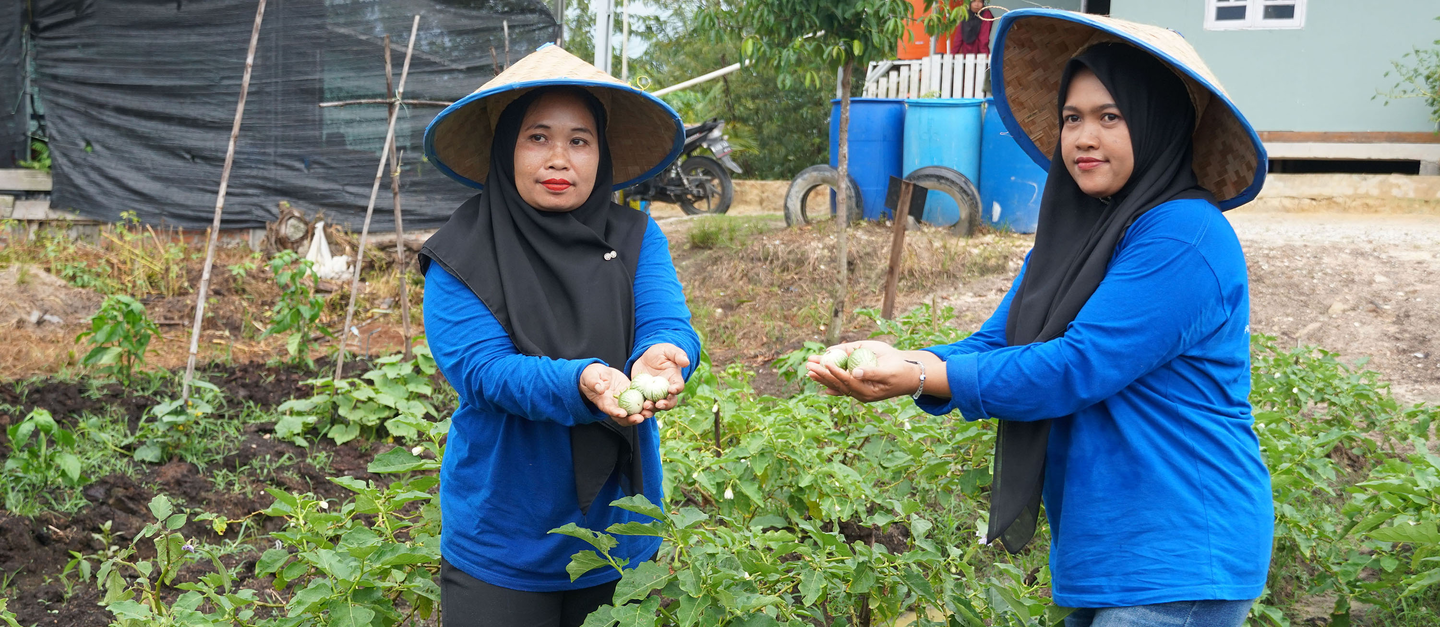
The second phase is putting the framework into practice. An ongoing pilot – running from 2023 to 2026 – has overseen the establishment of two agroforestry pilots. Communities are implementing agroforestry on 30 hectares of degraded peatland in Dayun and 5.7 hectares of mineral soil in Rambahan. The land-use streams are separated, and the business arrangement is shared. Both plots were planted by the end of 2024.